What a GJSPC report is
GJSPC, the Gem & Rudraksha Testing Laboratory in New Delhi, is an independent laboratory. When it tests a Rudraksha it records its findings about that one bead and stores them under a unique report number. The printed report card is a copy of that record. The record itself lives in the laboratory's database, which is why you can check it online.
A report is only useful if it is one-on-one: one bead, one report, one number. A single certificate that covers a batch of beads cannot tell you anything about the bead in your hand.
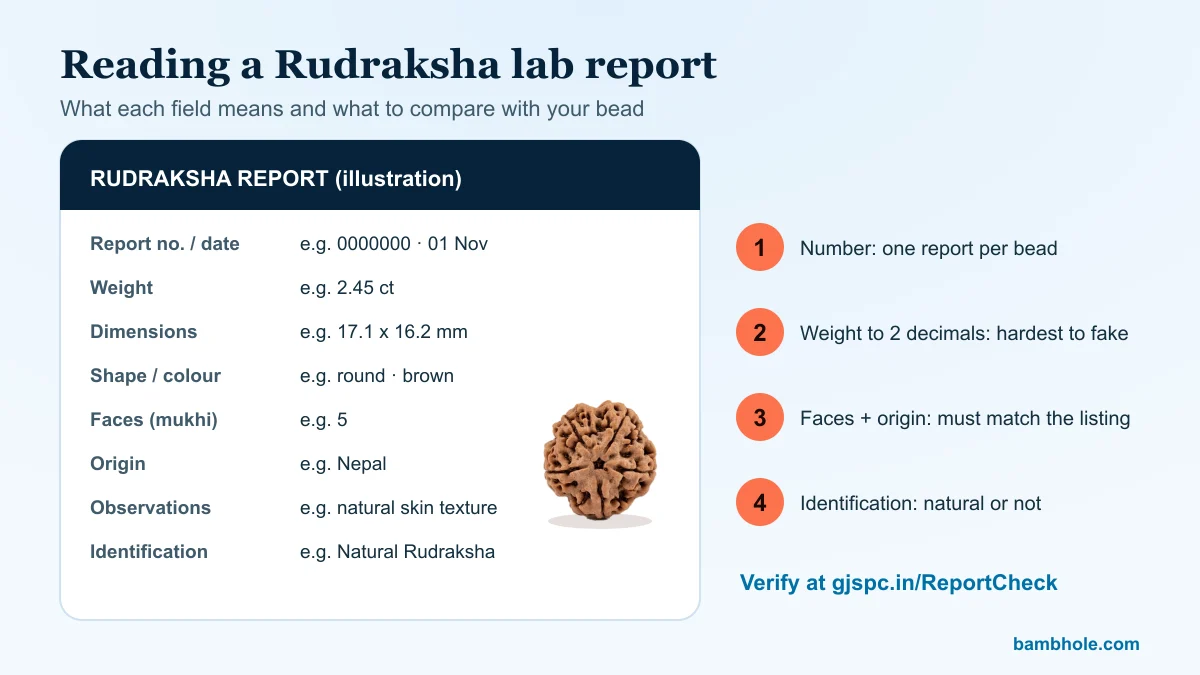
The report, field by field
| Field | What it means | What to check |
|---|---|---|
| Report number and date | The unique ID of this bead's record and the day it was tested. | Enter it at gjspc.in/ReportCheck. It must return a record. |
| Weight | The bead's weight in carats (1 carat = 0.2 grams), usually to two decimal places. | If you have a jeweller's scale, weigh the bead. This is the hardest value to fake. |
| Dimensions | Length, width and depth in millimetres. | Measure across the bead. It should fall inside the size range you ordered. |
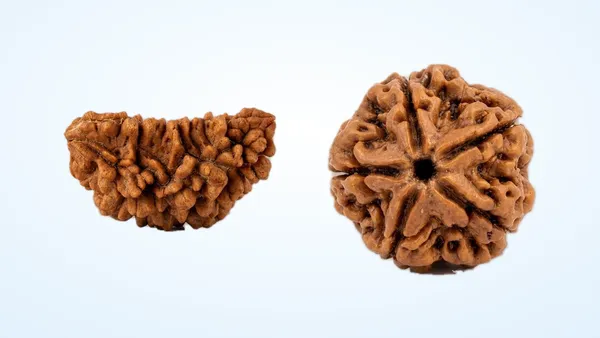
| Shape and colour | How the lab describes the outline (round, oval, half-moon) and colour. | A quick visual match with your bead. |
| Number of faces | The mukhi count the laboratory confirmed. | It must match what you paid for. |
| Origin | Where the bead comes from, for example Nepal or Indonesia. | It must match the listing. Origin affects price. |
| Internal examination | Whether the laboratory imaged the inside of the bead. | This is how chambers, carved lines and joins are checked. |
| Observations | Microscope notes, such as natural skin texture and fibres. | Notes on treatment or damage deserve a question. |
| Identification | The laboratory's conclusion, for example "Natural Rudraksha". | This is the line that matters most. |
Our lab certification page explains how the laboratory's internal examination works and what it can reveal.
How to verify a report online
- Type gjspc.in/ReportCheck into your browser yourself. Do not rely on a link sent by a seller, because a look-alike website is an easy trick.
- Enter the report number exactly as printed, including any letters.
- Compare the result with your bead and with the printed card: identification, weight, dimensions, faces and origin.
- If anything does not match, write to the seller with the report number and what you found.
GJSPC notes that its online check may not show every detail printed on the original report. It confirms that the report exists and that its key details match.
What a lab report does not tell you
- Spiritual results. A laboratory records material, origin and treatment. It does not certify spiritual or astrological effects.
- Price or value. The report describes the bead, not what it should cost.
- Energisation. Rituals performed before or after testing are not part of a laboratory report.
Report number vs printed report card
At Bambhole every Rudraksha is lab tested and has its own report number, which is shown on the product page for one-of-a-kind beads and supplied with your order. Printed report card: free on beads from ₹1,000; ₹150 below that. The number is what you verify. The card is a convenient printed copy.
Warning signs on any report
- No report number, or a number that returns nothing online.
- Weight given in whole numbers only, or with no weight at all.
- The seller's own name in place of an independent laboratory.
- The same report shown for several different beads.
Want to see reports in practice? Browse the lab-tested Rudraksha beads, or read how to check if a Rudraksha is real.
Questions people ask
How do I verify a GJSPC Rudraksha report?
Type gjspc.in/ReportCheck into your browser, enter the report number exactly as printed, and compare the identification, weight, dimensions, faces and origin with your bead.
Why is the weight on a Rudraksha report so precise?
The weight is recorded in carats, usually to two decimal places. No two natural beads weigh exactly the same, so a precise weight ties the report to one bead and is very hard to fake.
Does a lab report prove a Rudraksha's spiritual power?
No. A laboratory report records material, origin and treatment findings. It does not certify spiritual or astrological results, which are traditional beliefs.
Is the printed report card free at Bambhole?
The printed report card is free on beads priced ₹1,000 or more and costs ₹150 per bead below that. Every bead has a report number either way.
Spiritual associations described here come from tradition. They are not medical claims or promises of a particular result.